Pages

Thursday, June 8, 2017

Sialorrhoea: Causes and Clinical Features


Definition:
It is an excessive salivation from mouth.


Causes:@ I M HARI
I = Local Irritation
M = Medications eg. Cholinergic antagonists
H = Heavy metal Poisoning
A = Apthous ulcers
R = Rabies
I = Ill fitting dentures

Clinical Features:
1. Drooling
2. In children: Macerated sores or ulceration

Wednesday, May 24, 2017

Development of Tongue

I. Epithelium of tongue:
1 Anterior 2/3rd part:
-From two lingual swellings and one tuberculum impar which arises from 1st branchial arch.
- Nerve supply:
    a. Lingual nerve
    b. Chorda tympani nerve

2. Posterior 1/3rd part:
- From cranial large part of hypobranchial eminence i..e. from 3rd arch.
- Nerve supply: Glossopharyngeal nerve

3. Posteriormost part:
- From 4th branchial arch
- Nerve supply: Vagus nerve

II. Muscles:
- Develop from occipital myotomes
- Nerve supply: Hypoglossal nerve

III. Connective tissue:
- develops from the local mesenchyme

Paracetamol

Mechanism of action (MOA):
- It inhibits prostaglandin synthesis in the CNS by inactivating cyclooxygenase  and hence  explains antipyretic and analgesic effects (not peripherally).


Membrane phospholipids
                ↓ Phospholipase A
    Arachidonic acid
       Cyx. ↓x         ↓Lipoxygenase
Prostaglandins       Leukotrienes

Adverse effects (ADR):
1. Hepatotoxicity or hepatic necrosis
2. Nausea, dizziness, excitement, disorientation, rashes, leukoplakia @NiD2ER

Use:
1. As antipyretic drug (to treat fever)
2. As analgesic drug (to treat pain)

Contraindications:
1. Chronic alcoholics or severe hepatic impairment
2. Premature babies (<2 years)

Note:
1. Acute paracetamol poisoning:
- Due to overdose of paracetamol (fetal dose = 250 mg/kg)
Mechanism:
Paracetamol → From inactive metabolites  → Normally excreted
   Cyt. 450 ↓
            NAPQI (highly toxic metabolite) → Normally excreted
                 ↓
Covalently bind with sulfhydryl group
                 ↓
    Liver/ Kidney damage


2. Specific antidote for  paracetamol poisoning: N-acetylcysteine


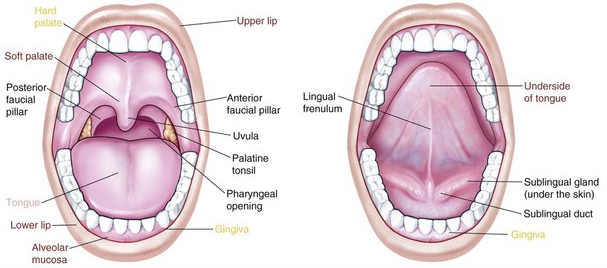
Oral Mucosa and it's Classification


Definition: 
Body cavity that communicate with the external surface are lined by mucous membranes, which are coated by serous and mucous secretions.


Extension of oral mucosa/oral mucous membrane:
Anteriorly: Lip through vermilion border
Posteriorly: Pharynx

Classification of oral mucosa:
A) On the basis of functional adaptation:
   a. Masticatory mucosa:
        Location: Gingiva, hard palate and dorsum of tongue
        - Bound to bone and doesn't stretch
        - Bears forces generated when food is chewed
   b. Lining or reflecting mucosa
        Location: Lip, cheek, vestibular fornix, alveolar mucosa, floor of mouth and soft palate
        - Covers musculature part and is distensible
        - Adapts itself to contraction and relaxation of cheeks, lips and tongue and to movement of mandible
   c. Specialized mucosa:
        Location: Dorsum of tongue and taste buds
        - Also called sensory mucosa
        - Bears taste buds having sensory function

B) On the basis of type of epithelium:
   a. Keratinized mucosa
   b. Non-keratinized  mucosa


Wednesday, May 17, 2017

MCQS From Adenoid cystic carcinoma: Malignant Tumours of Salivary Glands

1. 'Swiss cheese' or 'honey comb' pattern is characteristic feature of:
   a. Pleomorphic adenoma
   b. Adenoid cystic carcinoma
   c. Mucoepidermoid carcinoma
   d. Acinic cell carcinoma
Correct answer is b.

2. Cylindroma is another name of
   a. Pleomorphic adenoma
   b. Warthin's tumour
   c.Mucoepidermoid carcinoma
   d. Adenoid cystic carcinoma
Correct answer is d.

3. Pseudo-Adenomatous BCC is
   a. Pleomorphic adenoma
   b. Warthin's tumour
   c.Mucoepidermoid carcinoma
   d. Adenoid cystic carcinoma
Correct answer is d.

4. Cribriform, tubular, solid or cystic patterns of myoepithelial cells is a feature of:
   a. Pleomorphic adenoma
   b. Warthin's tumour
   c. Adenoid cystic carcinoma
   d. Mucoepidermoid carcinoma
Correct answer is c.

5. Perineural space invasion is a characteristic feature of
   a. Pleomorphic adenoma
   b. Warthin's tumour
   c. Adenoid cystic carcinoma
   d. Mucoepidermoid carcinoma
Correct answer is c.

6. Classical or most common pattern of Adenoid cystic carcinoma is
   a. Cribriform
   b. Solid
   c. Tubular
   d. None of the above
Correct answer is a.

Adenoid Cystic Carcinoma: Malignant Tumours of Salivary Glands

Other names:
1. Cylindroma
2. Adenocystic Basal Cell Carcinoma (BCC)
3. Pseudo-Adenomatous BCC
4. Basaloid mixed tumours

Definition:
It is a slow growing but aggressive neoplasm (recurrence is frequent), characterized by proliferation of ductal (luminal) and myoepithelial cells in cribriform, tubular, solid or cystic patterns.

Clinical features:
Same as mucoepidermoid carcinoma or pleomorphic adenoma except:
- Early local pain
- Fixation to deeper tissues
- Local invasion to perineural space and nerves

Histologic features:
1. composed of variable ductal cells and myoepithelial cells

2. Three growth patterns:
   a) Cribriform pattern: 
   - Classical, most common and best recognized pattern
   - Contains both luminal and non-luminal cells i.e. shows basaloid epithelial cell nests that form multiple cylindrical cyst like pattern called 'Swiss cheese' or 'honey comb' pattern

b) Tubular pattern: 
   - Shows only luminal/ ductal cells with single layer of basaloid cells or myoepithelial cells

c) Solid pattern:
- Shows non-luminal cells i.e. Solid groups of cuboidal cells with little tendency towards duct or cyst formation

Treatment: Surgical excision

Prognosis: Poor

MCQS


1. 'Swiss cheese' or 'honey comb' pattern is characteristic feature of:
   a. Pleomorphic adenoma
   b. Adenoid cystic carcinoma
   c.Mucoepidermoid carcinoma
   d. Acinic cell carcinoma
Correct answer is b.

2. Cylindroma is another name of
   a. Pleomorphic adenoma
   b. Warthin's tumour
   c.Mucoepidermoid carcinoma
   d. Adenoid cystic carcinoma
Correct answer is d.

3. Pseudo-Adenomatous BCC is
   a. Pleomorphic adenoma
   b. Warthin's tumour
   c.Mucoepidermoid carcinoma
   d. Adenoid cystic carcinoma
Correct answer is d.

4. Cribriform, tubular, solid or cystic patterns of myoepithelial cells is a feature of:
   a. Pleomorphic adenoma
   b. Warthin's tumour
   c. Adenoid cystic carcinoma
   d. Mucoepidermoid carcinoma
Correct answer is c.

5. Perineural space invasion is a characteristic feature of
   a. Pleomorphic adenoma
   b. Warthin's tumour
   c. Adenoid cystic carcinoma
   d. Mucoepidermoid carcinoma
Correct answer is c.

6. Classical or most common pattern of Adenoid cystic carcinoma is
   a. Cribriform
   b. Solid
   c. Tubular
   d. None of the above
Correct answer is a.